Smilax Glabra: The Sarsaparilla On The AlphaSteel Label
The panel does not just say sarsaparilla. It names the species, Smilax glabra, and the part, the root. Both details narrow down what the 20 mg on the label is, and what published work can honestly be set beside it.
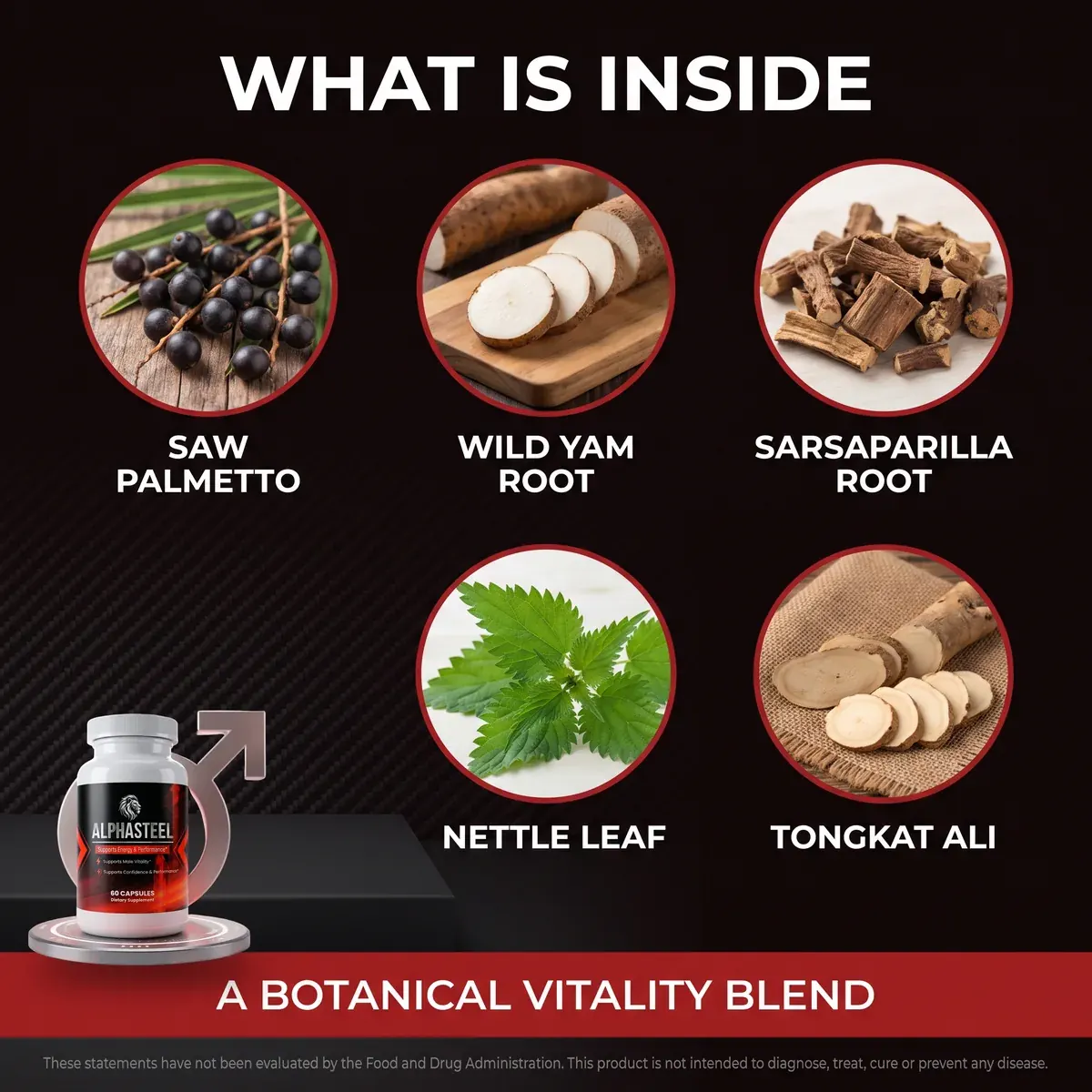
- The species: Smilax glabra, the sarsaparilla of traditional Chinese medicine, not one of the American species the soft drink was named after.
- The amount: 20 mg of root extract per two-capsule serving, one of five 20 mg rows on the panel.
- The research: Two reviews describe more than 200 identified compounds and a large laboratory literature, with few clinical studies.
- The comparison: The reviews cite no human dose trial, so the 20 mg has no research column to sit beside.
Which sarsaparilla the label means
‘Sarsaparilla’ is a trade name more than a botanical one. It has been used for the roots of several climbing plants in the genus Smilax, from Central and South America as well as Asia, and for a soft drink named after them. When a label says only sarsaparilla, a reader cannot tell which plant is meant.
The AlphaSteel panel is more specific. Its third row reads Sarsaparilla (Smilax glabra) root extract, 20 mg. Smilax glabra is the Asian species, known in traditional Chinese medicine as tu fu ling, and it has a literature of its own, reviewed in an ethnopharmacology review (Hua 2018).
That specificity is useful. It means the species can be looked up, its research read, and the amount on the label compared with something real, which is more than a bare trade name allows.
The plant, and the part the panel names
Smilax glabra is a climbing vine of southern China and neighbouring parts of Asia. The part used in traditional practice grows underground: a thick, knotted rhizome, which labels and pharmacopoeias commonly call the root. The AlphaSteel panel prints root extract, which matches that use.
An extract is a concentrate, made by soaking the dried plant in a solvent and keeping what dissolves. The sarsaparilla row prints no extract ratio, unlike the tongkat ali and horny goat weed rows, so the 20 mg is simply the weight of extract in one serving. The NIH background on botanical supplements explains how extracts like this are made and labelled.
What the literature on Smilax glabra covers
Two reviews map the published work. The 2022 review by Wu and colleagues covered research up to April 2022 and counted more than 200 compounds identified in the plant. Most of the work it describes was done on crude extracts and isolated compounds, in cells and in animals, and the authors point to a lack of clinical and toxicity studies.
The earlier ethnopharmacology review traces the plant’s traditional use and its laboratory pharmacology, again largely in vitro and in animals.
Neither review describes a trial in which men took a Smilax glabra extract by mouth at a stated dose and were measured for vitality or energy. That is not a criticism of the plant; it is where the research stands, and a reader should know it before trusting any claim built on this ingredient.
| Review | What it covers | Human dose data |
|---|---|---|
| Wu 2022 | Traditional use, more than 200 compounds, pharmacology to April 2022 | None described; the authors note a lack of clinical studies |
| Hua 2018 | Tu fu ling in traditional Chinese medicine; in vitro and animal work; astilbin as the marker compound | None described |
How to read a review of a traditional plant
A review that counts two hundred compounds and dozens of pharmacological properties can read like a strong case. It helps to sort the evidence by where it was produced, because each level answers a different question.
| Kind of study | What it can show | What it cannot show |
|---|---|---|
| In vitro (cells or enzymes) | That a compound can act on a target under laboratory conditions | Whether it reaches that target in a person, at a realistic amount |
| Animal | Effects in a whole body, often at high amounts per kilogram | Whether the same happens in people, at a capsule’s amount |
| Human trial | An effect in a named group of people, at a stated amount, over a stated time | Anything about groups or amounts it did not test |
Most of the Smilax glabra literature sits in the first two rows. That makes it useful for understanding the plant, and not yet useful for predicting what 20 mg of root extract does in a man. A compound that acts in a dish can be present in a capsule in amounts far too small to matter, or be broken down before it gets anywhere; only the third row can settle that, and for this plant the third row is nearly empty.
What the reviews say about safety
The 2022 review notes a lack of toxicity studies as well as clinical ones. That is a gap in knowledge, not evidence of harm, and it cuts both ways: it means nobody can promise the plant does anything in people, and nobody has measured its safety at scale in people either.
For a buyer the practical rules do not change. The AlphaSteel label sets the amount, two capsules a day, and asks you not to exceed it; its caution names who should check first. Those two lines are the safety instructions for every row on the panel, sarsaparilla included, and the safety page takes each active in turn.
Astilbin, the marker compound
Among those two hundred compounds, one does most of the practical work in quality control. Astilbin, a flavonoid, is the marker the ethnopharmacology review identifies for Smilax glabra material: a laboratory can measure it to confirm that a batch of root is the species it claims to be, and to compare one batch with another.
The AlphaSteel panel gives the extract weight, 20 mg, rather than a marker-compound figure. The two answer different questions. A marker figure describes the extract’s chemistry; the weight describes how much extract is in the capsule. The panel answers the second, which is the one a buyer comparing labels can use.
What 20 mg can be compared with
This is where care matters most. Set the sarsaparilla row beside a row that does have a human trial, saw palmetto and the CAMUS trial, and the difference shows at once: one research cell carries an amount, the other carries none.
| Ingredient, as the label prints it | What the cited research used | Per AlphaSteel serving |
|---|---|---|
| Saw palmetto (Serenoa repens) berry extract | 320 mg a day, raised to 640 and 960 mg over 72 weeks, in men with urinary symptoms. No better than placebo (Barry 2011). | 20 mg |
| Sarsaparilla (Smilax glabra) root extract | No human dose trial. Reviews describe crude-extract laboratory work and a lack of clinical studies (Wu 2022). | 20 mg |
For saw palmetto the 20 mg on the panel is easy to place. For Smilax glabra the reviews cite no human dose trial, so there is no research figure to set the 20 mg beside. What remains is context. The sarsaparilla row is one of five rows at the same weight, and about a sixth of the 118 mg total. It is there as one part of a seven-part formula, not as a stand-alone dose of anything studied in people.
If you want one sentence to carry away: Smilax glabra is a real, documented traditional plant with a large laboratory literature, and the 20 mg on the AlphaSteel label cannot be matched to a human trial because the reviews describe none.
Where it sits on the AlphaSteel panel
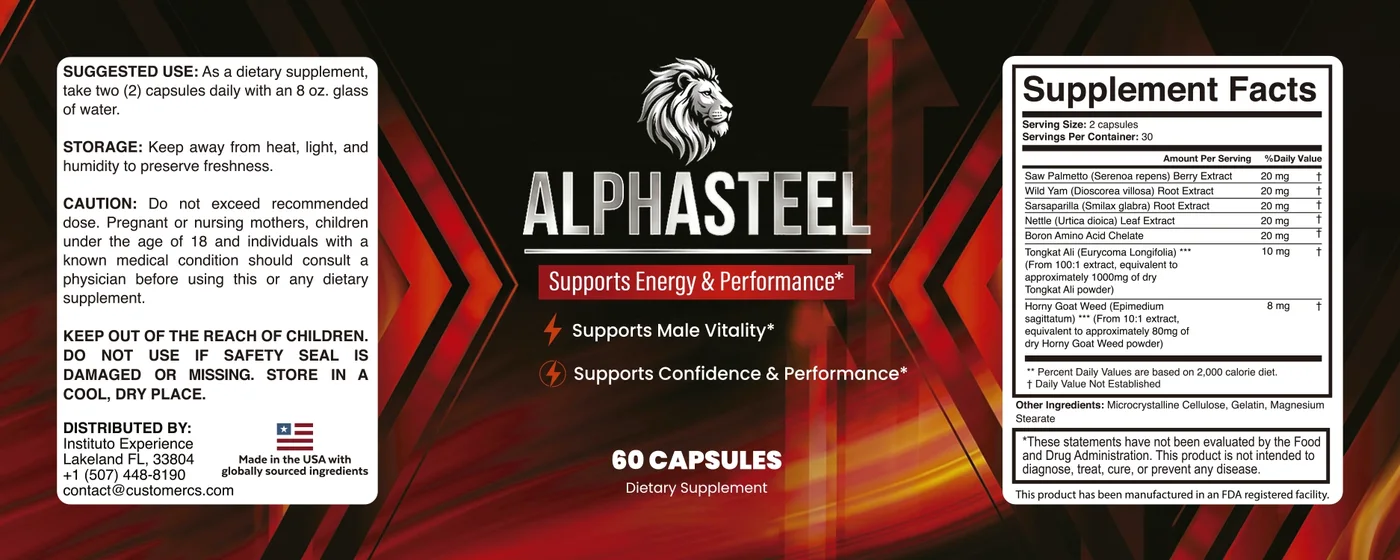
| Row | Ingredient | Part or form | Per 2 capsules |
|---|---|---|---|
| 1 | Saw Palmetto (Serenoa repens) | berry extract | 20 mg |
| 2 | Wild Yam (Dioscorea villosa) | root extract | 20 mg |
| 3 | Sarsaparilla (Smilax glabra) | root extract | 20 mg |
| 4 | Nettle (Urtica dioica) | leaf extract | 20 mg |
| 5 | Boron | amino acid chelate | 20 mg |
| 6 | Tongkat Ali (Eurycoma longifolia) | 100:1 extract | 10 mg |
| 7 | Horny Goat Weed (Epimedium sagittatum) | 10:1 extract | 8 mg |
Five rows weigh 20 mg each; the two extract rows weigh 10 mg and 8 mg, with dry-powder equivalents printed beside them. Sarsaparilla sits third, between wild yam and nettle. The label page reproduces the whole panel, and the ingredients page takes each active in turn.
Three questions for any sarsaparilla claim
- Which species? Smilax glabra, one of the American species, or just ‘sarsaparilla’ with no name at all.
- Which part? Root, rhizome or something else, and in what form: powder or extract.
- Which kind of study? Cells, animals or people, and if people, who and at what amount.
On the AlphaSteel label the first two questions are answered on the panel itself. The third is answered by the reviews above, and the answer, for now, is mostly cells and animals.
Why a species name on a label is worth reading
- It tells you which plant is meant, where a trade name could mean several.
- It lets you find the research on that species, and notice when there is little of it.
- It lets you look the plant up in government references such as NCCIH’s Herbs at a Glance.
- It pairs with the part named on the row, root, leaf or berry, and the part can change the chemistry entirely.
The same habit pays off across the AlphaSteel panel. Nettle is printed as leaf extract, and the leaf has a different research record from the root; the species and the part on each row are what let a reader tell the two apart.
AlphaSteel is a dietary supplement, not a treatment for any condition, and its label claims support for energy and performance, male vitality, and confidence and performance, nothing more. The label asks pregnant or nursing mothers, anyone under 18 and anyone with a known medical condition to consult a physician before using any dietary supplement.
Sources cited in this article
- Barry MJ, Meleth S, Lee JY, Kreder KJ, Avins AL, Nickel JC, et al. Effect of increasing doses of saw palmetto extract on lower urinary tract symptoms: a randomized trial. JAMA. 2011;306(12):1344-51. doi:10.1001/jama.2011.1364 https://pubmed.ncbi.nlm.nih.gov/21954478/
- Wu H, Wang Y, Zhang B, Li YL, Ren ZX, Huang JJ, et al. Smilax glabra Roxb.: A Review of Its Traditional Usages, Phytochemical Constituents, Pharmacological Properties, and Clinical Applications. Drug Des Devel Ther. 2022;16:3621-3643. doi:10.2147/DDDT.S374439 https://pubmed.ncbi.nlm.nih.gov/36277602/
- Hua S, Zhang Y, Liu J, Dong L, Huang J, Lin D, et al. Ethnomedicine, Phytochemistry and Pharmacology of Smilax glabra: An Important Traditional Chinese Medicine. Am J Chin Med. 2018;46(2):261-297. doi:10.1142/S0192415X18500143 https://pubmed.ncbi.nlm.nih.gov/29433390/
- National Center for Complementary and Integrative Health. Herbs at a Glance. https://www.nccih.nih.gov/health/herbsataglance
- NIH Office of Dietary Supplements. Botanical Dietary Supplements: Background Information. https://ods.od.nih.gov/factsheets/BotanicalBackground-Consumer/